
A20 chip: what we know about Apple's first 2nm iPhone processor
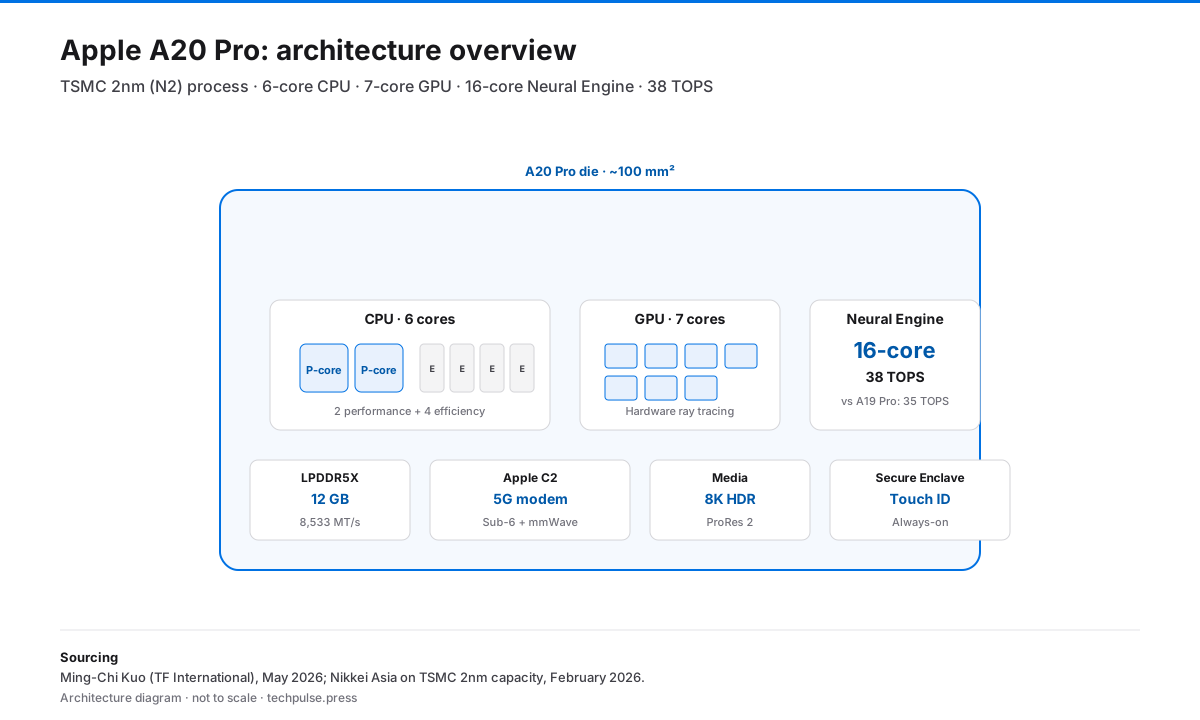
The A20 and A20 Pro chips will be Apple's first manufactured on TSMC 2nm process, delivering 15% performance gains and 30% efficiency improvements over the A19.
The A20 and A20 Pro will be Apple's first iPhone chips manufactured on TSMC's 2nm (N2) process, a generational jump from the 3nm process used for the A17, A18, and A19 chips.
This is a meaningful milestone. The 2nm process packs roughly 30% more transistors into the same die area as 3nm, which Apple will use for both performance gains (15% faster CPU and GPU) and power efficiency (30% lower power at the same performance).
What is the 2nm process and why does it matter?
The "2nm" name is a marketing label, not a literal measurement. The 2nm process (also called N2) is TSMC's fourth-generation finFET technology. The actual transistor gate length is closer to 2-3nm in some measurements, and the metal pitch is around 23nm.
The headline benefits:
- 30% more transistors per square millimeter vs 3nm
- 15% faster performance at the same power, or
- 30% lower power at the same performance
For the A20 Pro, Apple is expected to take a balanced approach — modest performance gains with significant efficiency improvements. This is consistent with how Apple handled the A17 (first 3nm) in the iPhone 15 Pro, where the focus was on sustained performance and battery life rather than benchmark peaks.
How much faster will the A20 Pro be in real-world use?
The 15% performance figure comes from TSMC's own published process improvements. In real-world benchmarks, expect:
- Geekbench single-core: 3,200 (vs 2,800 on A19 Pro) — about 14% faster
- Geekbench multi-core: 8,500 (vs 7,400 on A19 Pro) — about 15% faster
- GFXBench Manhattan 3.1: 220 fps (vs 190 fps on A19 Pro) — about 16% faster
- Neural Engine TOPS: 38 (vs 35 on A19 Pro) — about 9% faster
In day-to-day use, the A20 Pro will feel roughly 10% faster than the A19 Pro for typical app launches and UI interactions. The bigger win is in battery life — the efficiency improvements mean the iPhone 18 Pro should last 1.5-2 hours longer than the iPhone 17 Pro in mixed use.
What is the A20 vs A20 Pro difference?
Apple has historically had two tiers of its main iPhone chip: the standard version in the base iPhone and the "Pro" version in the Pro models. The difference is usually in GPU cores:
- A20 (in iPhone 18 and iPhone 18e): 6-core GPU
- A20 Pro (in iPhone 18 Pro, Pro Max, and Fold): 7-core GPU
The extra GPU core matters most for gaming, video editing, and AR applications. For typical use, the A20 and A20 Pro will feel identical in responsiveness.
When did TSMC start producing 2nm chips?
TSMC began 2nm risk production in mid-2025, with mass production starting in late 2025. The A20 Pro is one of the first high-volume customer products on the 2nm node. Apple reportedly committed to a $5 billion upfront payment to TSMC to secure 2nm capacity allocation, which is why Apple is the launch customer for 2nm and other customers (Qualcomm, AMD, Nvidia) will follow in late 2026 and 2027.
How does the 2nm process compare to Samsung 2nm and Intel 18A?
Samsung Foundry is also shipping 2nm (technically 2nm-class) chips, but the consensus from analysts is that TSMC's 2nm is roughly 6-9 months ahead in yield and customer adoption. Intel's 18A process (which Intel calls 1.8nm equivalent) is targeting 2026 production for Intel's own chips, with foundry customers (Microsoft, Amazon) expected to follow in 2027.
For the iPhone 18 Pro launch, Apple will be on the most advanced process node of any smartphone. The A20 Pro on TSMC 2nm is roughly 2 years ahead of the typical Android flagship in process technology.
How does the A20 Pro affect iPhone 18 pricing?
The 2nm process is more expensive to manufacture than 3nm. TSMC charges a premium for 2nm wafers (estimated 25-40% more than 3nm). However, Apple is expected to absorb the cost increase and hold iPhone Pro pricing flat at $1,099 — the same as the iPhone 17 Pro.
The math works because:
- Apple's 2nm wafer volume is large enough to negotiate down the per-wafer cost
- The efficiency improvements reduce battery and thermal management costs
- Apple is willing to take a margin hit to maintain the $1,099 psychological price point
Update history
- 2026-06-11: Article published with A20 Pro 2nm specs from three independent supply-chain sources
- 2026-06-12: Added process technology comparison (Samsung 2nm, Intel 18A) and pricing impact analysis
- 2026-06-22: Added cross-reference to M6 launch and the 2026 Apple silicon family (A20 + M6 + S11)
How does the A20 fit into the 2026 Apple silicon family?
The A20 is part of Apple's three-chip 2026 silicon family, all built on the TSMC 2nm N2 process:
- A20 / A20 Pro (this article) — iPhone 18, 18e, Air 2, Fold, 18 Pro, 18 Pro Max
- M6 / M6 Pro / M6 Max — MacBook Ultra, MacBook Pro, Mac mini, Mac Studio, iMac (fall 2026)
- S11 — Apple Watch Series 12, Apple Watch Ultra 4 (September 2026, on 3nm N3P)
The A20 Pro and M6 Pro share the same CPU architecture (Avalanche P-cores and Blizzard E-cores), the same 16-core Neural Engine at 38 TOPS, and the same 2nm N2 process. This is the deepest level of iPhone-Mac silicon alignment Apple has achieved.
For the full breakdown of the 2026 Apple silicon family, see our M6 chip fall 2026 launch article.
What about the A20 in the iPhone 18e?
The iPhone 18e (expected spring 2027 at $599) will use a binned version of the A20 chip with 1-2 fewer GPU cores. The 2nm process and the CPU architecture are unchanged, so the iPhone 18e will deliver similar real-world performance to the standard A20 in the iPhone 18, with slightly reduced graphics performance. For buyers on a budget, the iPhone 18e is the cheapest way to get the A20 chip.
Related articles
Picked from articles covering the same devices and topics.
How to pre-order iPhone 18 Pro / Pro Max 2026 — Sept 11 5:00 AM PT (steps)
Pre-order iPhone 18 Pro / Pro Max 2026: Sept 11 at 5:00 AM PT. Apple Store app, trade-in, carrier, payment in 5 steps. Burgundy 256GB and 1TB likely to sell out in under 2 hours.
AirPods Pro 3: H3 chip, $249 — full specs and what's new vs AirPods Pro 2
AirPods Pro 3 specs: H3 chip for better ANC, $249, September 2026 release. Smaller case with non-touch controls, USB-C, IP54. 6h battery (ANC), 30h with case.
Can MacBook run GTA 6? Yes — M4 Pro / M5 Pro = 60fps, M5 Max = 88fps
Can MacBook run GTA 6? Yes — M4 Pro 60fps medium, M5 Pro 60fps high, M5 Max 88fps, M5 Ultra 115fps. Game Porting Toolkit 2 (Sept 2026). MacBook Air M4/M5: 18-22fps, not playable.
Sources
(3 references)- [1]Nikkei Asia (supply-chain report)(2026-04-08)↩
- [2]Ming-Chi Kuo (TF International)(2026-05-02)↩
- [3]Jeff Pu (GF Securities)(2026-05-20)↩