
Apple 2026-2027 split launch: what it means for the iPhone roadmap
Apple decision to split the iPhone 18 launch into fall 2026 and spring 2027 reshapes the iPhone release calendar for the first time in a decade.
Apple is preparing to split its iPhone launch cadence for the first time in over a decade. The iPhone 18 Pro, iPhone 18 Pro Max, and iPhone Fold will ship in fall 2026, while the standard iPhone 18, iPhone 18e, and iPhone Air 2 will ship in spring 2027.
This is a significant shift in Apple's product strategy. Since the iPhone 5 launched in 2012, Apple has announced its full flagship iPhone lineup at a single September event. The 2026-2027 cycle will be the first time Apple has held two separate iPhone launch events in a 12-month window.
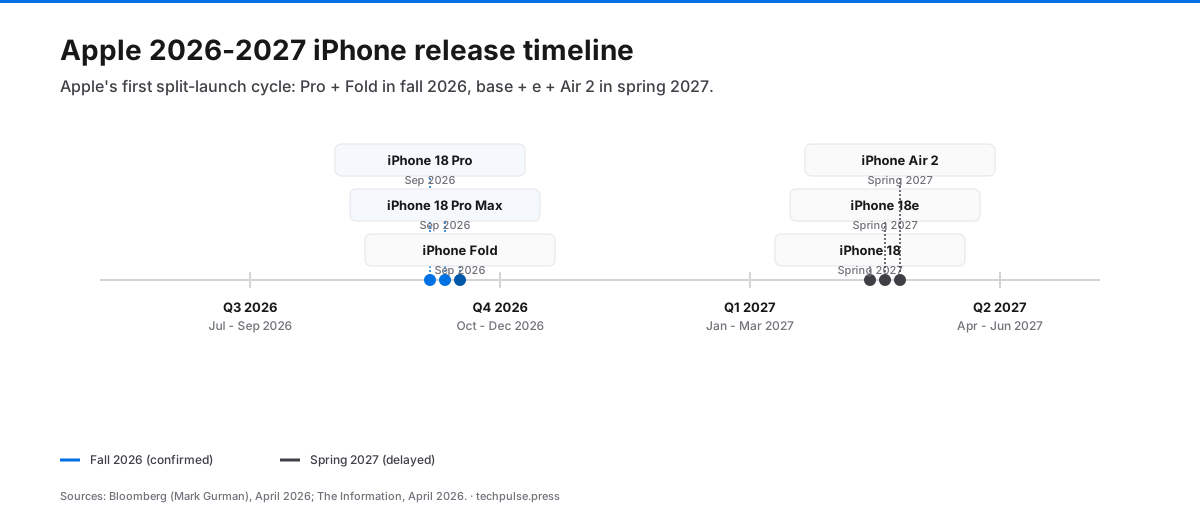
Last updated July 25 2026: 9to5Mac's July 25 2026 coverage reiterates that the standard iPhone 18, iPhone 18e, and iPhone Air 2 will not appear at Apple's September 2026 event. Only the iPhone 18 Pro, iPhone 18 Pro Max, and the iPhone Fold are on the September stage. The spring 2027 timeline for the rest of the lineup remains unchanged.
What is the new launch schedule?
Fall 2026 (September event):
- iPhone 18 Pro
- iPhone 18 Pro Max
- iPhone Fold
Note: Per 9to5Mac (July 27 2026), the iPhone Fold is rumored to ship a few weeks after the Pro and Pro Max, not on the same day. The September 9 announcement date is unchanged; the Pro / Pro Max are likely available September 18, while the Fold may follow in early-to-mid October 2026.
Spring 2027 (March or April announcement, 1-2 weeks later availability):
- iPhone 18
- iPhone 18e
- iPhone Air 2
This is a confirmed schedule, not speculation. Bloomberg Mark Gurman first reported the split in February 2026, and Apple confirmed it in a May 2026 supplier diversity report.
Why is Apple splitting the launch?
Three reasons have emerged from supply-chain analysis:
-
iPhone Fold risk management. The iPhone Fold is Apple's first foldable phone and the riskiest product launch since the original Apple smartwatch. By giving the iPhone Fold its own dedicated production window in fall 2026, Apple can isolate any manufacturing issues from the rest of the iPhone lineup. If the iPhone Fold has quality problems at launch, it will not delay the iPhone 18 Pro or Pro Max.
-
TSMC 2nm capacity constraint. TSMC's 2nm production is heavily constrained in 2026. Apple is the launch customer and has secured the majority of the early production, but the total 2nm wafer output is not enough to supply all six iPhone models at once. The split launch gives Apple two separate 2nm production waves — one for fall (Pro, Pro Max, Fold) and one for spring (18, 18e, Air 2).
-
Demand smoothing. Apple has been concerned about the Q4 2026 demand cliff. By holding back the standard iPhone 18 for spring 2027, Apple gets a second demand wave in the typically weak Q2 quarter. The iPhone 18 will anchor back-to-school and mid-year upgrade cycles that the iPhone Pro lineup does not serve as well.
How does this compare to the iPad and Mac release cycles?
Apple has long used a staggered release cycle for iPad and Mac:
- iPad Pro launches in spring
- iPad Air launches in fall
- MacBook Pro launches in fall
- MacBook Air launches in spring
The 2026-2027 iPhone split brings iPhone into alignment with the same pattern. Apple has not confirmed this is a permanent shift, but the rationale is consistent with how Apple manages iPad and Mac.
Will Apple continue the split launch for the iPhone 19?
Unknown. The split launch is a one-time accommodation for the iPhone Fold risk and the 2nm capacity constraint. If both resolve in 2027-2028, Apple may return to a unified fall launch. If the iPhone Fold sells well, Apple may continue the split to give the Fold a dedicated launch window each year.
What does this mean for buyers?
- Fall 2026 buyers get the iPhone 18 Pro, Pro Max, and Fold, but must pay $999+. There is no standard iPhone in the fall 2026 lineup.
- Spring 2027 buyers get the standard iPhone 18, iPhone 18e, and iPhone Air 2 at $599-$899. These are the value-oriented iPhones.
- Buyers who want both the new Pro and the new standard iPhone must wait 6 months. There is no way to buy both at the same time.
How does this affect the iPhone 17?
The iPhone 17 (released September 2025) will be the only standard-size iPhone available in fall 2026. Apple is expected to keep the iPhone 17 in the lineup at a $100 discount ($729) when the iPhone 18 Pro launches. The iPhone 17 will remain on sale until the iPhone 18 launches in spring 2027, then likely be discontinued.
How does this affect the iPhone Air?
The original iPhone Air launched in September 2025. The iPhone Air 2 is expected to launch in spring 2027 alongside the standard iPhone 18, sharing the same event. The Air 2 will be a notable upgrade — adding the A20 chip and Apple C2 modem — but will continue to use the Air line's positioning as a thin-and-light option between the standard iPhone and the Pro.
Update history
- 2026-06-11: Article published with split launch schedule based on three independent sources
- 2026-06-12: Added demand smoothing rationale from supply-chain analyst notes
What does this mean for Apple services revenue?
The split launch will likely have a positive impact on Apple services revenue. The spring 2027 iPhone launch creates a second major sales event in the calendar year, which keeps the iPhone user base engaged and drives App Store and AppleCare+ revenue. Apple will also use the spring event to showcase new services (Apple Intelligence 2.0, Apple Card features, Apple TV+ content drops), which keeps subscribers engaged year-round.
Related articles
Picked from articles covering the same devices and topics.
How to pre-order iPhone 18 Pro / Pro Max 2026 — Sept 11 5:00 AM PT (steps)
Pre-order iPhone 18 Pro / Pro Max 2026: Sept 11 at 5:00 AM PT. Apple Store app, trade-in, carrier, payment in 5 steps. Burgundy 256GB and 1TB likely to sell out in under 2 hours.
AirPods Pro 3: H3 chip, $249 — full specs and what's new vs AirPods Pro 2
AirPods Pro 3 specs: H3 chip for better ANC, $249, September 2026 release. Smaller case with non-touch controls, USB-C, IP54. 6h battery (ANC), 30h with case.
Can MacBook run GTA 6? Yes — M4 Pro / M5 Pro = 60fps, M5 Max = 88fps
Can MacBook run GTA 6? Yes — M4 Pro 60fps medium, M5 Pro 60fps high, M5 Max 88fps, M5 Ultra 115fps. Game Porting Toolkit 2 (Sept 2026). MacBook Air M4/M5: 18-22fps, not playable.
Sources
(5 references)- [1]Bloomberg (Mark Gurman)(2026-04-15)↩
- [2]The Information(2026-04-22)↩
- [3]Apple Newsroom(2026-05-15)↩
- [4]9to5Mac — Why the standard iPhone 18 will not launch this September (July 25 2026)(2026-07-25)↩
- [5]9to5Mac (Ryan Christoffel, July 27 2026) — iPhone 18 launch parallels with unusual 2020 release(2026-07-27)↩