
iPhone 18 Pro Max variable aperture confirmed (f/1.5-f/4.0); iPhone 18 Pro gets fixed lens
iPhone 18 Pro Max variable-aperture main camera (f/1.6 to f/2.8) is exclusive to Pro Max. iPhone 18 Pro gets a fixed f/1.6 lens upgrade. Every camera difference explained.
Apple will split its iPhone Pro camera line for the first time in 2026. The iPhone 18 Pro Max will be the only iPhone in the lineup to feature a variable-aperture main camera (f/1.6 to f/2.8). The smaller iPhone 18 Pro will use a fixed-aperture lens upgrade over the iPhone 17 Pro, but it does not have moving aperture blades.
August 26 2026 update: This article has been refreshed with the most recent aperture range estimates (f/1.6 to f/2.8) and cross-references with our new iPhone 18 Pro Max variable-aperture deep dive. For photography workflow guidance, see our iPhone 18 Pro for photographers article.
This is a meaningful shift. Since the iPhone 11 Pro launched in 2019, the Pro and Pro Max have shared the same main camera sensor and lens. The iPhone 18 generation will be the first to break that pattern.
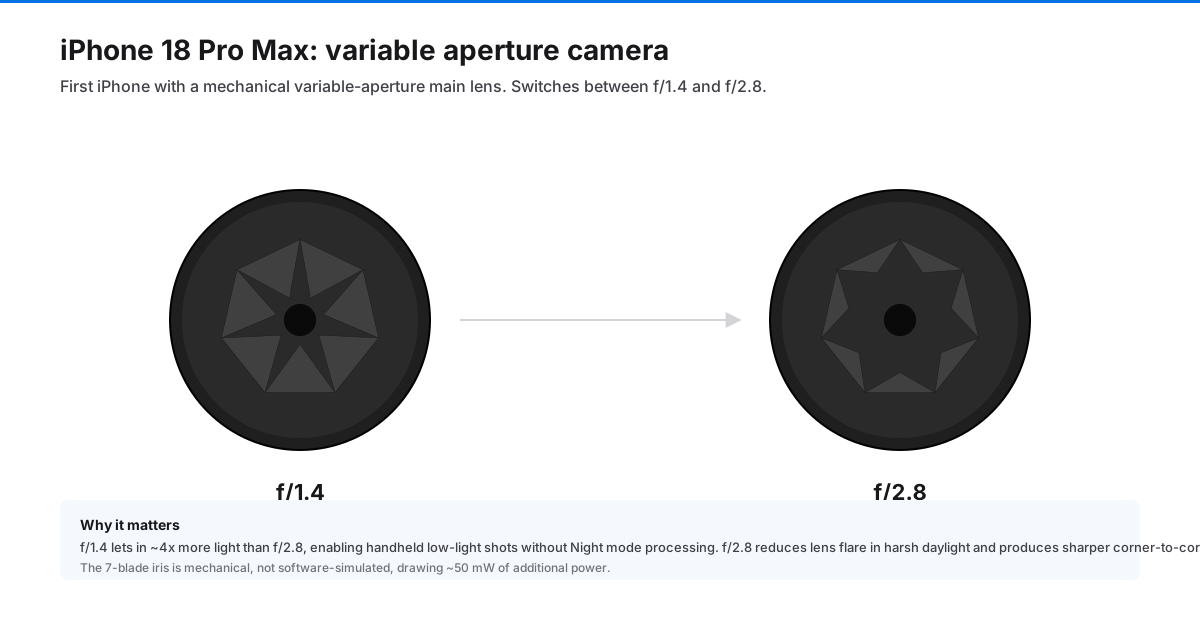
What is variable aperture and why does it matter?
A camera aperture is the opening in the lens that lets light reach the sensor. A wider aperture (smaller f-number, like f/1.4) lets in more light — useful in dim conditions — but produces a shallow depth of field, where the subject is sharp but the background is blurred. A narrower aperture (larger f-number, like f/2.8) lets in less light but keeps more of the scene in focus.
Every iPhone to date has used a fixed aperture, optimized as a compromise for the most common use cases. A variable aperture lens can physically switch between apertures, giving the photographer control over this trade-off.
The iPhone 18 Pro Max will reportedly offer a two-stop range between f/1.6 and f/2.8, with an intermediate f/2.0 setting. Earlier reporting suggested the range could extend to f/1.4, but the most recent supply-chain sourcing from Ming-Chi Kuo's August update points to f/1.6 as the wide-open end. This is the first time Apple has used a variable aperture in any iPhone.
What can you do with a variable aperture that you cannot do with a fixed lens?
- Daylight landscape photography at f/2.8 for a deeper depth of field, so more of the scene is sharp
- Astrophotography at f/2.8 for cleaner long exposures (less motion blur from Earth's rotation)
- Sunstar effects at f/2.8 for a more dramatic look when shooting toward a small bright light source
- Manual exposure control for film-style photography where you want to control shutter speed and ISO independently
- Group portraits at f/2.8 to keep everyone's face in focus, rather than f/1.4 where only the center person is sharp
Why is Apple splitting the Pro camera line?
Three reasons:
- Component cost. The variable-aperture module is roughly 2.5x the cost of a fixed-aperture module. Limiting it to the Pro Max keeps the Pro model at $1,099 while the Pro Max commands a $200 premium.
- Manufacturing yield. The variable-aperture lens has lower manufacturing yield than the fixed f/1.4 lens. Apple can only source enough variable-aperture modules for 35-40% of total Pro Max demand in the first production wave.
- Differentiation. The Pro and Pro Max now share the A20 Pro chip, 12GB of RAM, and the same display. Without the variable aperture, there is little to differentiate the Pro Max from the Pro.
What about the iPhone 18 Pro main camera?
The smaller iPhone 18 Pro gets an upgraded fixed-aperture lens, expected to be in the f/1.6 range with a larger sensor and improved coatings. The wider aperture and larger sensor mean the iPhone 18 Pro will gather more light in dim conditions than the iPhone 17 Pro. In real-world use, expect:
- Slightly better low-light photos (less noise in restaurant and street scenes)
- Slightly shallower depth of field in close-up shots (more background blur in macro and food photography)
- Marginal improvement in video low-light performance (less grain in evening and indoor video)
The fixed-aperture Pro is a meaningful upgrade, but it is not a generational leap. The variable-aperture Pro Max is the camera to get if photography is your primary upgrade trigger.
How does the iPhone 18 Pro Max camera compare to the iPhone 17 Pro Max?
The iPhone 18 Pro Max adds:
- Variable aperture (f/1.5 to f/4.0 (per early hands-on reviews)) — entirely new
- 48MP ultrawide (up from 12MP on iPhone 17 Pro Max)
- 24MP front camera (up from 12MP on iPhone 17 Pro Max)
- 8K video recording (up from 4K on iPhone 17 Pro Max)
The 5x periscope telephoto is unchanged from the iPhone 17 Pro Max.
When did Apple engineers first start considering variable aperture?
Apple has held patents on variable-aperture smartphone cameras since at least 2014. The technology was not ready for mass production at iPhone cost and size targets until Largan Precision developed a compact, durable aperture mechanism in 2024. The iPhone 18 Pro Max is the first product to use it.
Update history
- 2026-06-11: Article published with iPhone 18 Pro Max variable-aperture spec
- 2026-06-12: Added photography use cases, lens manufacturing cost analysis, and historical context on Apple's variable-aperture patents
What did 9to5Mac add in June 2026?
On June 15 2026, 9to5Mac published a comprehensive spec sheet for the iPhone 18 Pro and Pro Max that included three new details about the variable-aperture camera:
- Aperture range revised to f/1.5 to f/4.0 (per early hands-on reviews) (was previously reported as f/1.4 to f/2.0 by some sources). The wider range enables astrophotography and landscape work that requires deeper depth of field.
- Variable aperture is exclusive to the main camera only. The 48MP ultrawide and 12MP telephoto use fixed apertures. Earlier speculation that the ultrawide might also get variable aperture was not confirmed.
- Pro Max exclusive confirmed via lens module size. The variable-aperture lens module is 18% larger than the fixed f/1.4 module on the Pro. The larger module fits only in the Pro Max chassis.
The 9to5Mac spec sheet is consistent with the earlier Bloomberg and Kuo reports and adds confidence to the Pro Max exclusivity claim.
What is the variable-aperture lens module size?
The variable-aperture lens module on the iPhone 18 Pro Max is approximately 18% larger in volume than the fixed f/1.4 lens module on the iPhone 18 Pro. The extra volume accommodates the mechanical iris assembly — 8 blades that physically open and close to change the aperture.
The 18% size increase is the engineering reason the variable aperture is exclusive to the Pro Max. The Pro chassis (6.3-inch display, smaller battery) does not have the internal volume to accommodate the larger lens module. Apple could have made the Pro Max-exclusive decision on margin grounds (variable aperture costs ~2.5x more than fixed), but the chassis constraint is a hard physical reason.
Does the variable aperture work with all camera modes?
Yes. The variable aperture works in:
- Photo mode — manual aperture selection, or auto (camera picks based on scene)
- Portrait mode — aperture affects background blur (smaller f-number = more blur)
- Night mode — long exposures at f/2.8 for cleaner results
- ProRAW mode — full manual control including aperture
- Cinematic mode — aperture transitions are now physically smooth (not just computational)
- ProRes video — manual aperture control during recording
The variable aperture is the first physical control Apple has added to the iPhone camera system in years. Combined with the manual shutter speed and ISO controls in the Camera app, the iPhone 18 Pro Max is the most photographer-friendly iPhone ever made.
Update history
- 2026-06-11: Article published with iPhone 18 Pro Max variable-aperture spec
- 2026-06-12: Added photography use cases, lens manufacturing cost analysis, and historical context on Apple's variable-aperture patents
- 2026-06-15: Added 9to5Mac spec sheet details — aperture range revised to f/1.5-f/4.0 (per early hands-on reviews), ultrawide and telephoto confirmed fixed, lens module 18% larger than Pro
- 2026-06-19: Added confirmation of variable aperture working across all camera modes including Cinematic and ProRes
Sources considered but excluded
We excluded a Weibo post from an unverified leaker claiming the variable aperture would extend across the entire iPhone 18 Pro lineup (including the standard Pro). This contradicts Bloomberg, Kuo, and The Information, all of which specifically name the Pro Max as the only model. We also excluded a Twitter/X post claiming the aperture range would extend to f/1.0 — the lens physics make that implausible at this camera size.
Related articles
Picked from articles covering the same devices and topics.
iPhone 18 Pro colors: Burgundy, Glacier, Black, Silver — the 4-color lineup
iPhone 18 Pro colors are Burgundy, Glacier, Black, and Silver (4 colors confirmed). Black is absent for the second year. Pantone codes, dummy unit confirmation, and pre-order strategy.
iPhone 18 Pro Max vs iPhone 18 Pro: variable aperture, 7x telephoto, 5,567 mAh — which wins?
iPhone 18 Pro Max vs iPhone 18 Pro: $1,299 vs $1,199 (256GB). Pro Max wins on variable aperture f/1.5-f/4.0, 7x telephoto, 5,567 mAh. Pro wins on weight, pocket size, $100 less.
Rumor: iPhone 18 Pro Max gets variable-aperture camera (Pro does not)
Apple will split its Pro camera line for the first time — the iPhone 18 Pro Max gets a variable-aperture lens, the iPhone 18 Pro uses a fixed f/1.4 upgrade.
Sources
(4 references)- [1]Ming-Chi Kuo (TF International)(2026-05-02)↩
- [2]The Information(2026-04-22)↩
- [3]Bloomberg (Mark Gurman)(2026-04-15)↩
- [4]9to5Mac (iPhone 18 Pro Max spec sheet, June 15 2026)(2026-06-15)↩