
August 12 2026 total solar eclipse: what US viewers see and how to photograph it on iPhone
A total solar eclipse crosses Greenland, Iceland and Spain on August 12 2026. The lower 48 US sees a partial eclipse at sunset — here is what is visible and how to photograph it on iPhone.
A total solar eclipse crosses the North Atlantic on August 12 2026, with the path of totality running from Greenland through Iceland and into northern Spain. The lower 48 United States does not fall inside the path of totality, but every US state will see a partial eclipse in the hours before sunset — and that is the part this audience can act on. Below is what NASA published, what viewers in the US will actually see, how to watch safely, and how to photograph the partial phases on iPhone.
Time-sensitive: this article is about an event that has already happened by the time of your next visit. We are keeping it live for photography reference and as a record of the 2026 August 12 sky event.
The eclipse at a glance (NASA Five Millennium Canon)
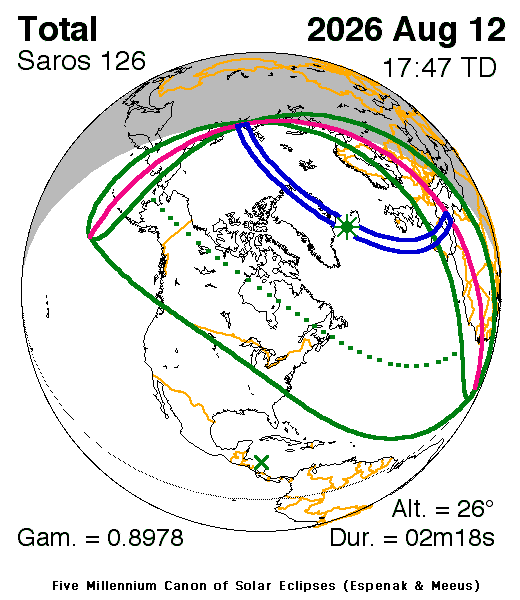
These numbers come straight from NASA's published catalog entry for August 12 2026, sourced from the Five Millennium Canon of Solar Eclipses:
| Parameter | Value |
|---|---|
| Type | Total solar eclipse |
| Date | 2026 August 12 |
| Greatest eclipse (UT) | 17:46 |
| Eclipse magnitude | 1.03863 |
| Gamma | 0.89774 |
| Central duration | 2 minutes 18 seconds |
| Path width | 294 km |
| Greatest eclipse point | 65.2°N, 25.2°W (off the coast of Greenland) |
| Sun altitude at greatest eclipse | 26° |
| Saros series | 126 (member 48 of 72) |
The path of totality enters the Earth surface at sunrise over the Arctic, runs northeast-to-southwest across Greenland, clips Iceland, then crosses the Bay of Biscay and ends in northern Spain just before sunset. The detailed path is in NASA's interactive eclipse map for 2026 August 12.
What the US will actually see
The contiguous United States is outside the path of totality, which is over the North Atlantic. What US viewers see instead is a partial solar eclipse low in the western sky during the late afternoon and early evening of August 12 2026.
The exact start time, peak magnitude, and end time depend on where you are in the US. NASA does not publish static city-by-city tables for the 2026 August 12 eclipse the way it did for the 2017 and 2024 US eclipses (those static tables are 404 on the modern site). The authoritative source for US city times is the interactive NASA eclipse map linked above — type your city into the map and it returns local start, peak, and end times plus the percentage of the Sun covered.
A few things are true for every US location regardless of state:
- Direction: the eclipse happens with the Sun low in the western sky, so a clear western horizon matters more than your latitude.
- Local peak: in the eastern US the eclipse will already be in progress when the Sun sets; in the mountain time zone the eclipse peaks close to sunset; on the West Coast the Sun sets before the eclipse begins.
- Magnitude: the further north and east you are, the larger the percentage of the Sun that is covered at peak. The further south and west, the smaller the bite and the closer to sunset.
- No totality anywhere in the lower 48: do not wait for totality — it will not come. The "diamond ring" effect and corona are only visible inside the path of totality over Iceland and Spain.
Why we do not list per-state times here: NASA has not published a static US city-by-city table for this eclipse, and we do not want to estimate times when there is a free authoritative tool that gives them to the second. Use the NASA interactive map for your city.
How to watch safely (NASA guidance)
The single most important rule, repeated by every NASA-affiliated eclipse educator: you must never look directly at the Sun without proper eye protection, except during the brief window of totality. For a partial eclipse — which is what the US sees — there is no safe-without-protection moment at all. The partial phases are never safe to view naked-eye.
What you need:
- Eclipse glasses that meet ISO 12312-2 (the international safety standard for direct solar viewing). Look for the ISO logo and the manufacturer's name printed on the frame. Do not use sunglasses — they do not block enough of the harmful wavelengths.
- #14 welder's glass as an alternative if you cannot find ISO-certified eclipse glasses. Anything darker than #14 is also fine.
- Pinhole or indirect projection as a no-glasses option. Cross the fingers of one hand over the other with a small gap between them; the gaps project a tiny "pinhole image" of the partially eclipsed Sun onto the ground. Trees with leafy canopies do the same thing.
- Solar filters for any optical device — camera lens, binoculars, telescope. The Sun's energy is concentrated enough to permanently damage camera sensors and to burn retinas through the viewfinder within a single frame.
If you cannot get ISO 12312-2 glasses before August 12, the safest move is to use indirect projection or watch a livestream. NASA and the Exploratorium typically run eclipse livestreams from inside the path of totality.
How to photograph the partial eclipse on iPhone
This is where techpulse earns its keep on an off-niche topic. iPhones — particularly iPhone 17 Pro, iPhone 17 Pro Max, iPhone 18 Pro, and iPhone 18 Pro Max — are the most common cameras people will point at the eclipse, and the wrong setup will damage the hardware or produce a useless image.
1. Use a solar filter on the lens (mandatory during partial phases)
Pointing any camera — phone or DSLR — at the Sun without a solar filter during partial phases will:
- Damage the lens coating and sensor over multiple frames.
- Wash the image into an unrecognizable bright disk with no detail.
- Create a permanent ghost image on the sensor if you leave the camera pointed for a long exposure.
For an iPhone, the practical solution is a phone-mounted solar filter — a thin sheet of Baader AstroSolar or Thousand Oaks ND 5.0 film held in front of the lens with a rubber-band or phone-case clamp. ISO 12312-2 eclipse glasses taped over the lens work in a pinch; the lens sees through the same polymer that protects your eyes.
Without a solar filter, you cannot photograph the partial phases at all — the Sun is too bright and the camera will smear.
2. The one moment you can remove the filter
Inside the path of totality — over Iceland, Spain, or Greenland — there is a roughly 2-minute window when the Moon completely covers the Sun and it is safe to remove the solar filter and photograph the corona. This is the only safe moment. The instant the first sliver of the Sun reappears (the "diamond ring"), put the filter back.
If you are in the lower 48 US, you never reach totality. Keep the filter on the entire time.
3. iPhone camera settings for partial eclipse
With a solar filter on the lens, you have plenty of light to spare, and the Sun's disk is small in the frame. Settings that work well:
- Shoot in ProRAW (iPhone 12 Pro and later): gives you headroom to pull back highlight detail in the corona and adjust white balance after the fact. ProRAW is enabled in Settings → Camera → Formats → ProRAW & Resolution Control.
- Lock exposure and focus on the Sun: in the Camera app, long-press on the Sun to lock AF/AE. The phone will hold exposure as the Moon's disk moves across the Sun.
- Use the 2x or 5x telephoto lens for a larger Sun disk in the frame. On iPhone 17 Pro / 18 Pro, the 5x telephoto (tetraprism) is the better choice; on older Pro models the 2x is the practical limit.
- Bracket exposures: hold the shutter and slide the exposure compensation slider from -2 to +2 EV. You will discard most frames, but one will have the corona / chromosphere detail you want.
- Shoot 4K ProRes video during the partial phases for a time-lapse record. The compression is manageable and you can pull individual frames later.
- Stabilize the phone: a small tripod or a phone mount on a stable surface. The 5x telephoto amplifies shake.
4. Indirect eclipse photography without a filter
If you cannot get a solar filter, you can still record the eclipse by photographing the projection instead of the Sun:
- Cross-stitch pinhole projection on a white card or the sidewalk.
- Colander or slotted spoon shadow projection — each hole acts as a pinhole.
- Telescope or binoculars projection onto a white card (do not look through the binoculars at the Sun).
Photograph the projection with any iPhone camera setting. The image will show the partially eclipsed Sun as a crescent.
5. Apple Watch + iPhone coordination
If you want a time-stamped series of images for science (citizen-science projects like Eclipse Megamovie accept these):
- Start a Camera Remote session on Apple Watch so you can trigger the iPhone shutter without touching the phone and bumping the tripod.
- Use the iPhone's built-in time-lapse mode to capture one frame every 30 seconds; you can stitch the sequence in Photos or iMovie later.
What to do if you want the actual totality
The path of totality is over Iceland and northern Spain on August 12 2026. If you want the real thing — corona, diamond ring, totality — you need to be in:
- Iceland: the Reykjavik area sees the eclipse in the late afternoon with the Sun above the horizon. The path crosses Iceland around 17:30-17:45 local time.
- Northern Spain: Bilbao, Santander, Zaragoza, Valencia. The eclipse ends at sunset.
- Greenland and Arctic cruise ships: less practical for most readers.
For European totality, plan for the trip now — flights and Reykjavik hotels in the path-of-totality zone were selling out in early 2026. Livestream options from NASA and the Exploratorium will be the free alternative.
What to do in the US if you miss it
The next total solar eclipse visible from the contiguous United States is August 23 2044 — eighteen years away. After that, the next one is May 2045 (a coast-to-coast event similar to 2017). So this partial eclipse is the last reasonable chance for a generation of US viewers to see the Sun reduced to a thin crescent. Worth a clear western horizon and an hour outside.
Sources and references
- NASA Eclipse Web Site — 2026 catalog entry — magnitude, duration, path width, gamma
- NASA interactive eclipse map — August 12 2026 — click any US city for local start/peak/end and percentage
- NASA path map GIF — global path of totality
- NASA Saros 126 reference — series context for this eclipse
- NASA Heliophysics education materials — ISO 12312-2 safety guidance, indirect projection methods
Related on techpulse
- iPhone 18 Pro camera variable aperture explained — what the variable aperture does for daytime photography
- iPhone 18 Pro main camera enlarged module — sensor-size change for the September 2026 generation
- iPhone 18 pre-launch summary (August 7 2026) — full state of the iPhone 18 cycle one month before the event
The photography guidance here applies directly to current-generation iPhones (17 Pro / Pro Max and the 18 Pro / Pro Max when it ships September 18). The eclipse is a useful real-world test for the variable-aperture main lens that the 18 Pro Max is expected to introduce — partial phases at high sun-angle are exactly the kind of bright-daylight photography where stepping down to f/2.8 has the biggest practical effect.
--- Last updated August 11 2026.
Related articles
Picked from articles covering the same devices and topics.
iPhone 18 trade-in: max $1,000 (T-Mobile beats Apple Oct 2026)
iPhone 18 trade-in max Oct 2026: T-Mobile up to $1,000 (beats Apple's $850 GiveBack). Verizon $900, AT&T $830. Stack carrier + Apple for up to $1,300 total savings.
Can MacBook run GTA 6? Yes — M4 Pro / M5 Pro = 60fps, M5 Max = 88fps
Can MacBook run GTA 6? Yes — M4 Pro 60fps medium, M5 Pro 60fps high, M5 Max 88fps, M5 Ultra 115fps. Game Porting Toolkit 2 (Sept 2026). MacBook Air M4/M5: 18-22fps, not playable.
iPhone 18 Pro Max vs 17 Pro Max: only upgrade for camera (worth $1,299?)
iPhone 18 Pro Max vs 17 Pro Max: variable-aperture camera (Pro Max only), A20 Pro 2nm, 12GB RAM, 5,567 mAh (+16% battery). $1,299 vs $1,199. Worth it only for photographers.
Sources
(4 references)- [1]NASA Eclipse Web Site (Fred Espenak, GSFC) — Five Millennium Canon of Solar Eclipses, 2026 August 12 entry(2026-08-05)↩
- [2]NASA interactive eclipse map — Total Solar Eclipse of 2026 August 12 (MapLibre viewer with Bessel elements)(2026-08-05)↩
- [3]NASA path map — 2026-08-12 global eclipse path GIF (5MCSEmap series)(2026-08-05)↩
- [4]NASA Saros 126 series reference (eclipse belongs to series 126, member 48 of 72)(2026-08-05)↩